
Some brands are built. Others are conjured — summoned into cultural relevance through a combustive alignment of timing, instinct, and technological circumstance. Fashion Nova belongs emphatically to the second category. What began in 2006 as a modest Los Angeles mall boutique specialising in jeans and clubwear has metastasised into one of the most-discussed, most-copied, and most-commercially-ferocious brands in the history of fast fashion. Its trajectory is not merely a business story. It is a sociological phenomenon, a case study in digital-age consumer psychology, and a portrait of an industry being remade in real time.
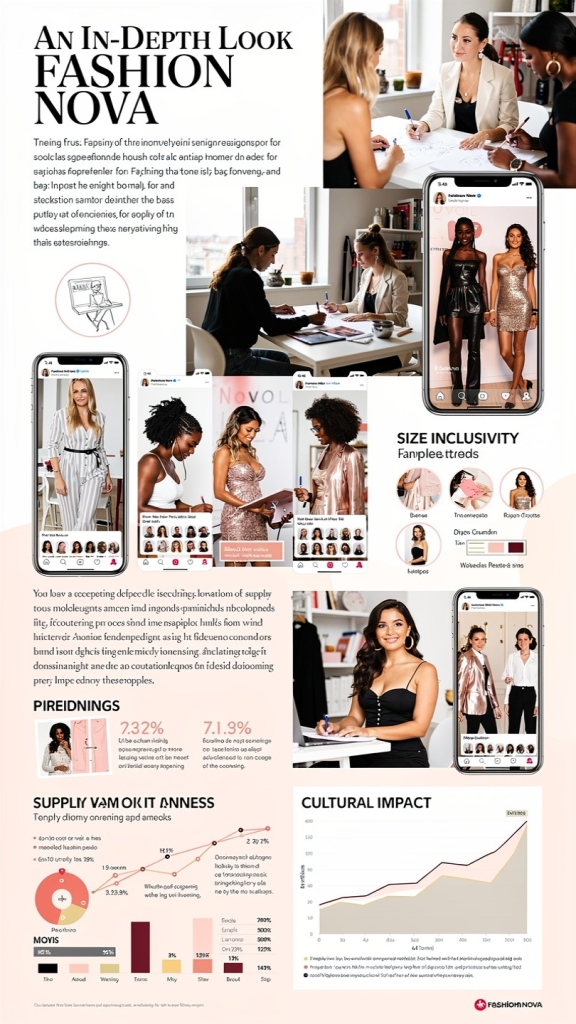
To understand Fashion Nova is to understand the precise intersection at which social media, influencer culture, body inclusivity, and hyper-accelerated production cycles converged to create something with no precedent in the retail lexicon.
The Genesis: From Mall Boutique to Digital Empire
Richard Saghian launched Fashion Nova out of a single retail location in the Panorama Mall in Pacoima, California. The concept was straightforward — affordable, figure-flattering clothing aimed at women who wanted to look dressed up without paying luxury prices. The early offerings skewed toward bodycon silhouettes, curve-embracing denim, and clubwear that the mainstream fashion industry was only tepidly producing at accessible price points.
The pivotal transformation came in 2013. Recognising that the future of retail was migrating inexorably online, Saghian made the consequential decision to transition Fashion Nova into a primarily e-commerce operation. This was not, at the time, the obvious move for a brand built on physical retail; the instinct required both prescience and nerve. The brand built its digital infrastructure on Shopify, a platform whose scalability would prove essential as the company’s growth accelerated beyond all initial projections.
By 2018, something extraordinary had occurred. Fashion Nova was the most Googled fashion brand in the world — outperforming Louis Vuitton, Versace, and Gucci. A scrappy Los Angeles streetwear label, operating without a single traditional advertising campaign, had eclipsed the most storied names in the industry. The mechanism behind this achievement was as radical as the outcome itself.
The Influencer Engine: A Revolutionary Marketing Architecture
Fashion Nova‘s approach to marketing represents perhaps its most significant contribution to the business of fashion. In an industry that had spent decades funnelling enormous budgets toward glossy magazine placements, billboard campaigns, and high-production editorial shoots, Saghian built something categorically different: a distributed content engine powered by thousands of human voices rather than a handful of curated ones.
The architecture operates on two interdependent tiers. At the apex sit high-profile celebrity collaborations — partnerships with figures like Cardi B and Kylie Jenner whose reach extends into the hundreds of millions. These marquee relationships generate the initial velocity, the headline-worthy buzz that draws mainstream media attention and lends institutional credibility to a brand that otherwise operates outside traditional fashion’s power structures. When Kylie Jenner posted a photograph wearing Fashion Nova to her then-180 million Instagram followers in 2018, it generated three million likes and a measurable surge in website traffic that validated the entire celebrity partnership model in a single post.
But the celebrity tier, spectacular as it is, functions primarily as a launchpad. The real propulsive power of Fashion Nova‘s marketing resides in the tens of thousands of nano and micro-influencers — creators with followings between 1,000 and 50,000 — who constitute the brand’s distributed content army. Rather than investing the entirety of its marketing budget in a small number of expensive celebrity deals, Fashion Nova routes that capital through a vast network of relatable, demographically diverse creators who post authentic content from their own lives and wardrobes. The brand compensates many of these collaborators not with cash but with product gifting, stretching the marketing budget to remarkable effect: instead of spending $50,000 on a single celebrity partnership, the same sum can equip 200 micro-influencers with $250 worth of product each, generating 200 pieces of organic content that reach audiences specifically attuned to each creator’s niche.
The result is what marketing strategists have termed “feed saturation through authenticity” — a condition in which the brand appears to be everywhere simultaneously, worn by people who look like the audience rather than aspirationally remote from it. In 2019 alone, Fashion Nova invested $40 million in celebrity and influencer partnerships, generating $111.9 million in earned media value. Its quarterly EMV consistently reaches $15.3 million. These are not figures that emerge from traditional advertising spend — they are the product of a systematised human content operation with few parallels in the industry.
The Cardi B Collaboration: A Cultural Watershed
Of all the celebrity relationships that have characterised Fashion Nova‘s ascent, none has proven more mutually transformative than its long-running partnership with rapper and cultural polymath Cardi B. The collaboration represents a near-perfect alignment of brand identity and celebrity persona: both the brand and the artist occupy a cultural space that is simultaneously aspirational and accessible, glamorous and streetwise, unapologetically sexual and firmly rooted in working-class self-expression.
The inaugural Cardi B x Fashion Nova collection, launched in November 2018, reportedly sold out within minutes of its midnight release. Megan Thee Stallion’s collection, launched in November 2020, generated $1.2 million in sales within 24 hours. These are not merely commercial statistics — they are cultural events, moments at which the fashion industry’s customary hierarchies are visibly inverted, with a fast-fashion brand commanding the kind of fervent consumer response usually reserved for luxury limited editions.
What distinguishes the Cardi B partnership from conventional celebrity endorsement is its improvisational quality. Fashion Nova has built the infrastructure to develop, produce, and sell garments in what Saghian himself describes as a remarkably transactional timeframe — a capability that allows the brand to create looks inspired by a Cardi B lyric, or replicate an outfit she wears that goes viral, within days of the original appearance. This reactive production model transforms celebrity style moments into commercial products before the cultural conversation has even moved on, capturing demand at its most acute.
Ultra-Fast Fashion: The Production Engine
The velocity at which Fashion Nova operates its production cycle is, by any conventional measure, extraordinary. The brand introduces between 500 and 1,000 new styles every week — a cadence that has no close equivalent in the fast fashion landscape. This is accomplished through a network of approximately 1,000 manufacturers, the majority located in Los Angeles, whose geographical proximity to the brand’s operations allows for a compaction of the design-to-distribution timeline that offshore production simply cannot match.
This hyper-localised supply chain gives Fashion Nova a competitive capability that is genuinely difficult to replicate: the ability to identify an emerging trend on social media and have a retail-ready interpretation available for purchase within days. When a celebrity appears on a red carpet in a particular silhouette, or when a specific style generates viral momentum on TikTok or Instagram, Fashion Nova can translate that cultural signal into a purchasable product before the trend has had time to diffuse into the broader market. This positions the brand not as a follower of trends but as a mechanism for converting them into commercial reality at a speed that conventional fashion cycles cannot approach.
By 2024, this machine was generating annual revenues of approximately $1.011 billion, making Fashion Nova one of the most commercially successful privately held fashion companies in the United States. Founder Richard Saghian, who retains 100% ownership of the business, holds a personal net worth estimated at over $1.4 billion.
Inclusivity as Commercial Strategy and Cultural Commitment
One dimension of Fashion Nova‘s proposition that receives insufficient analytical attention in purely commercial discussions is its genuine commitment to size inclusivity. From early in its existence, the brand has offered extended sizing that the mainstream fashion industry has historically ignored or treated as an afterthought. The dedicated @fashionnovacurve account, which caters specifically to plus-size consumers, operates not as a tokenistic gesture but as a substantive commercial and creative proposition — one that photographs garments on multiple body types for the same product, allowing shoppers to visualise clothing on a figure that resembles their own.
This commitment resonates with particular power among consumers who have experienced chronic underrepresentation in fashion media and retail. For many of Fashion Nova‘s core customers, the brand’s willingness to celebrate and accommodate their bodies represents a form of acknowledgement that the broader industry has withheld. It is this emotional dimension — the sense of being seen, catered to, and valued — that transforms transactional customers into genuine brand advocates and propels the organic word-of-mouth that no paid campaign could manufacture.
Regulatory Entanglements and the Reckoning with Accountability
The commercial success and cultural influence of Fashion Nova have not insulated it from serious institutional scrutiny. The brand’s relationship with regulatory bodies has been contentious and costly.
In April 2020, the Federal Trade Commission alleged that Fashion Nova had withheld information from customers regarding the status of delayed orders, failing to provide them the opportunity to cancel unshipped merchandise and illegally compensating affected shoppers with gift cards rather than cash refunds. The settlement cost the brand $9.3 million.
A second, and arguably more reputationally significant, FTC action followed in January 2022. The commission alleged that Fashion Nova had, between late 2015 and mid-November 2019, suppressed hundreds of thousands of negative customer reviews — specifically, ratings below four stars — from appearing on its website, while allowing positive reviews to publish automatically. The mechanism artificially inflated the perceived quality of its products. The settlement required the brand to pay $4.2 million and prohibited it from continuing the practice. The case was, at the time, the first in FTC history to challenge a company specifically for concealing unfavourable online reviews — a landmark ruling whose implications extended well beyond Fashion Nova itself.
These regulatory encounters raise legitimate questions about the ethical foundations of the brand’s commercial practices, and they sit alongside broader fast fashion industry criticisms regarding labour conditions, environmental impact, and the social cost of disposable clothing culture. Intellectual property disputes have added further friction: Adidas has pursued the brand through litigation on multiple occasions, alleging design infringement, while Chrome Hearts has separately claimed that Fashion Nova copied a custom set created for an A-list celebrity.
The Beverly Hills Expansion: Institutionalising Cultural Capital
In a move that signals both ambition and a notable evolution in the brand’s self-conception, Fashion Nova acquired a premier Beverly Hills office campus in August 2024 — a transaction explicitly described as the future home of a “Content Creator Club.” The acquisition of prestigious real estate in one of the world’s most recognisable postal codes is a declaration of intent that extends beyond mere operational logistics. It positions Fashion Nova not as a scrappy e-commerce disruptor operating from the margins of the fashion establishment, but as a permanent institutional presence in the landscape of Los Angeles’s creative economy.
The Content Creator Club concept, meanwhile, codifies what has long been the brand’s most potent competitive advantage — its distributed network of content producers — into a physical infrastructure. Rather than relying solely on remote gifting relationships with influencers scattered across geographies, Fashion Nova is investing in a centralised creative facility capable of producing high-quality content at scale.
The Legacy and Continuing Pertinence of a Billion-Dollar Disruption
Fashion Nova is not simply a brand. It is a business model, a cultural signifier, a marketing methodology, and a provocation — a provocation to the fashion establishment, to regulatory frameworks, and to the comfortable assumptions of an industry that believed affordability and desirability were mutually exclusive.
Its success has redrawn the competitive map of fast fashion, compelling established players to accelerate their own production cycles and invest more heavily in influencer infrastructure. Its embrace of body diversity has applied pressure to an industry that has long preferred a narrow definition of the purchasable body. Its influencer marketing architecture has become, in the decade since it was pioneered, the industry standard — studied, copied, and refined by brands across every price tier.
The contradictions within Fashion Nova — between aspiration and accessibility, between inclusivity and regulatory misconduct, between cultural vitality and ecological cost — are real, consequential, and unresolved. They are also, in many ways, the contradictions of fast fashion itself, crystallised with unusual clarity in a single brand.
What is unambiguous is that Fashion Nova has permanently altered the retail landscape. The question of whether that alteration is ultimately beneficial — to workers, to consumers, to the environment, to the broader cultural conversation about clothing and identity — is one that the fashion industry, and the consumers who sustain it, will be grappling with for years to come.
The disruption was real. The reckoning is ongoing.
You may also like
-
The Comprehensive Dynamics of Melanin Ritual Skincare: Science, Routines, and Equity for Medium to Dark Skin Tones in 2025
-
The Comprehensive Framework for Melanin-Conscious Skincare: Evidence-Based Strategies for Hyperpigmentation, Brightening, and Barrier Resilience
-
The Global Resurgence of Ancestral Melanin Care: Tradition, Science, and Identity in Contemporary Skincare
-
The Essential Components of Melanin Ritual Skincare: A 2025 Breakdown of Dark Skin Radiance, Formulation Science, and Dermatological Precision for Rich Complexions
-
Sustainable Fashion: How the Industry is Shifting Toward Ethical and Eco-Friendly Practices